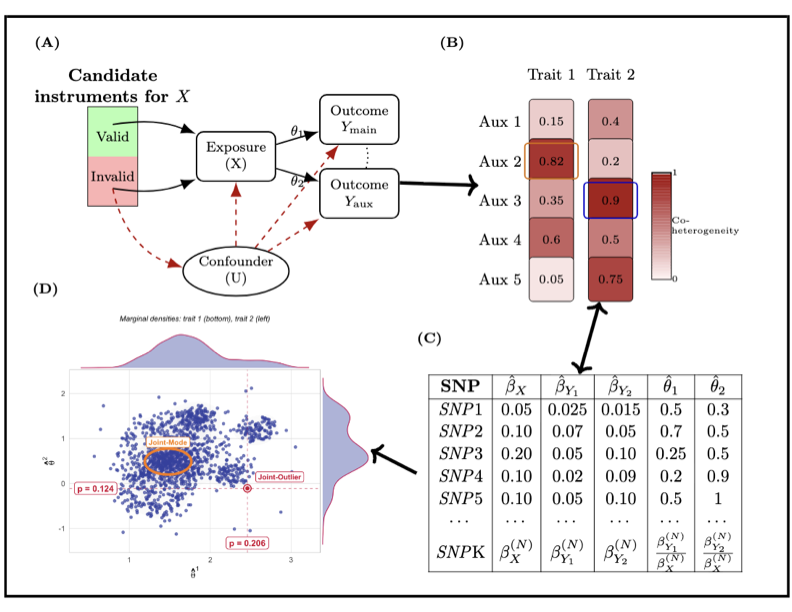
IBMR is an R package for instrument borrowing in Mendelian randomization (MR) using summary-level genetic association data. When a primary outcome shares overlapping valid instruments, or similar mechanisms of instrument invalidity, with a related auxiliary outcome for a given exposure, IBMR uses the auxiliary outcome to improve the robustness and efficiency of causal-effect estimation for the primary outcome.
The package provides three functions:
-
coheterogeneity_Q()— screens candidate auxiliary outcomes by quantifying their coheterogeneity with the primary outcome. -
IBMODE()— mode-based instrument-borrowing estimator (primary estimator). -
IBPRESSO()— MR-PRESSO-based instrument-borrowing estimator (secondary estimator).
Overview
Mendelian randomization estimates the causal effect of an exposure on an outcome using genetic variants as instrumental variables. Standard MR methods can lose power or become biased when many candidate instruments are invalid. IBMR mitigates this by borrowing information from a related auxiliary outcome that shares heterogeneity structure with the primary outcome. The analysis proceeds in two stages: candidate auxiliary outcomes are first screened with the coheterogeneity statistic, and the selected auxiliary outcome is then carried into the instrument-borrowing estimators.
Installation
Install from GitHub with:
install.packages("devtools")
devtools::install_github("achatto4/IBMR")
library(IBMR)
Preparing the input data
IBMR operates on harmonized, summary-level instrument–trait associations. Prepare the inputs as follows; where a step is also handled by coheterogeneity_Q(), the relevant argument is noted.
-
Instrument selection. Select independent instruments for the exposure by linkage-disequilibrium clumping and genome-wide-significance thresholding (for example,
p < 5e-8withr^2 < 0.001). Clumping and thresholding are performed externally;coheterogeneity_Q()additionally removes weak instruments through itsF_min(first-stage F statistic) andbx_minarguments. -
Harmonization. For the primary outcome and every candidate auxiliary outcome, align the association estimates to the exposure effect allele on the selected instrument set and remove ambiguous (palindromic) variants. This must be done before calling the package;
coheterogeneity_Q()assumes harmonized input. -
Sample overlap. Use a two-sample design in which the exposure GWAS sample does not overlap the outcome GWAS samples. Overlap between the two outcome samples is corrected internally: supply bivariate LD-score-regression intercepts via
ldsc_intercepts(withuse_ldsc = TRUE) andcoheterogeneity_Q()removes the induced cross-trait sampling covariance. The exposure–outcome non-overlap is assumed and not corrected. -
Sufficient heterogeneity. Coheterogeneity is informative only when the exposure–outcome pairs exhibit appreciable pleiotropic heterogeneity and enough instruments.
coheterogeneity_Q()enforces a minimum instrument count per pair viamin_K_pairand returns a diagnosticflagwhen a pair is degenerate or unstable.
Example
As a motivating illustration, one may wish to estimate the causal effect of an exposure (for example, body mass index) on a primary outcome (for example, coronary artery disease), borrowing instruments from a related auxiliary outcome (for example, type 2 diabetes). The bundled dataset ibmr_example is a simulated example of this setting — one exposure, one primary outcome, and two candidate auxiliary outcomes — and is not real GWAS data. In the simulation the exposure has a true positive effect on the primary outcome; Auxiliary_1 shares substantial invalid-instrument (pleiotropic) structure with the primary outcome, while Auxiliary_2 shares little.
Step 1 — Screen candidate auxiliary outcomes with coheterogeneity
library(IBMR)
data("ibmr_example")
dat <- ibmr_example

cohet_res <- coheterogeneity_Q(
  BetaXG          = dat$BetaXG,
  BetaYG_matrix   = dat$BetaYG_matrix,
  seBetaXG        = dat$seBetaXG,
  seBetaYG_matrix = dat$seBetaYG_matrix,
  F_min = 5,
  min_K_pair = 20
)

round(cohet_res$rho, 3)       # coheterogeneity of the primary outcome with each candidate
round(cohet_res$p_value, 4)   # and the significance of each estimate
#> Auxiliary_1 has the largest coheterogeneity with the primary outcome (~0.70).
We recommend selecting the candidate auxiliary outcome that is significantly coheterogeneous with the primary outcome and has the largest coheterogeneity — here Auxiliary_1. If no candidate is significantly coheterogeneous with the primary outcome, instrument borrowing is unlikely to add information; the analysis should then be approached with caution, or a standard single-outcome MR method used instead.
Step 2 — Estimate the causal effect by instrument borrowing
The selected auxiliary outcome is carried into the instrument-borrowing estimators. IBMODE() is the primary estimator; IBPRESSO() provides a complementary residual-based estimator.
sel <- c(dat$primary_trait, dat$recommended_auxiliary)   # "Primary", "Auxiliary_1"

# Primary estimator: mode-based instrument borrowing
ibmode <- IBMODE(
  BetaXG          = dat$BetaXG,
  BetaYG_matrix   = dat$BetaYG_matrix[, sel],
  seBetaXG        = dat$seBetaXG,
  seBetaYG_matrix = dat$seBetaYG_matrix[, sel],
  phi    = c(1, 0.5),
  n_boot = 200,
  seed   = 1
)

ibmode[, c("phi", "Estimate_Primary", "SE_Primary", "P_Primary")]
#> Estimate_Primary ~ 0.40 (recovers the true simulated effect)
# Secondary estimator: MR-PRESSO-based instrument borrowing
ibp <- IBPRESSO(
  BetaOutcome  = "BetaOutcome",
  BetaExposure = "BetaExposure",
  BetaAux      = "BetaAux",
  SdOutcome    = "SdOutcome",
  SdExposure   = "SdExposure",
  SdAux        = "SdAux",
  data         = dat$dat_ibpresso_aux1,
  OUTLIERtest  = TRUE,
  seed         = 1
)

c(estimate = ibp$corrected_beta, se = ibp$corrected_se,
  p = ibp$p_value, n_outliers = ibp$n_outliers)
#> corrected_beta ~ 0.40 after removing the shared-pleiotropy instruments
Both estimators recover the true simulated effect of the exposure on the primary outcome; IBPRESSO() additionally reports the instruments it flags as pleiotropic in ibp$outlier_idx.